Solunar FAQ
Solunar theory is one of the most talked-about concepts in fishing—but also one of the most misunderstood.
It is neither an “absolute” or a “scam” and both claims are commonly made. It’s one part of many factors you can consider when fishing.
This FAQ is a brief guide to answer some the most common questions clearly and practically. So you can use Solunar timing as part of a broader, real-world fishing strategy.
How often do Solunar periods occur?
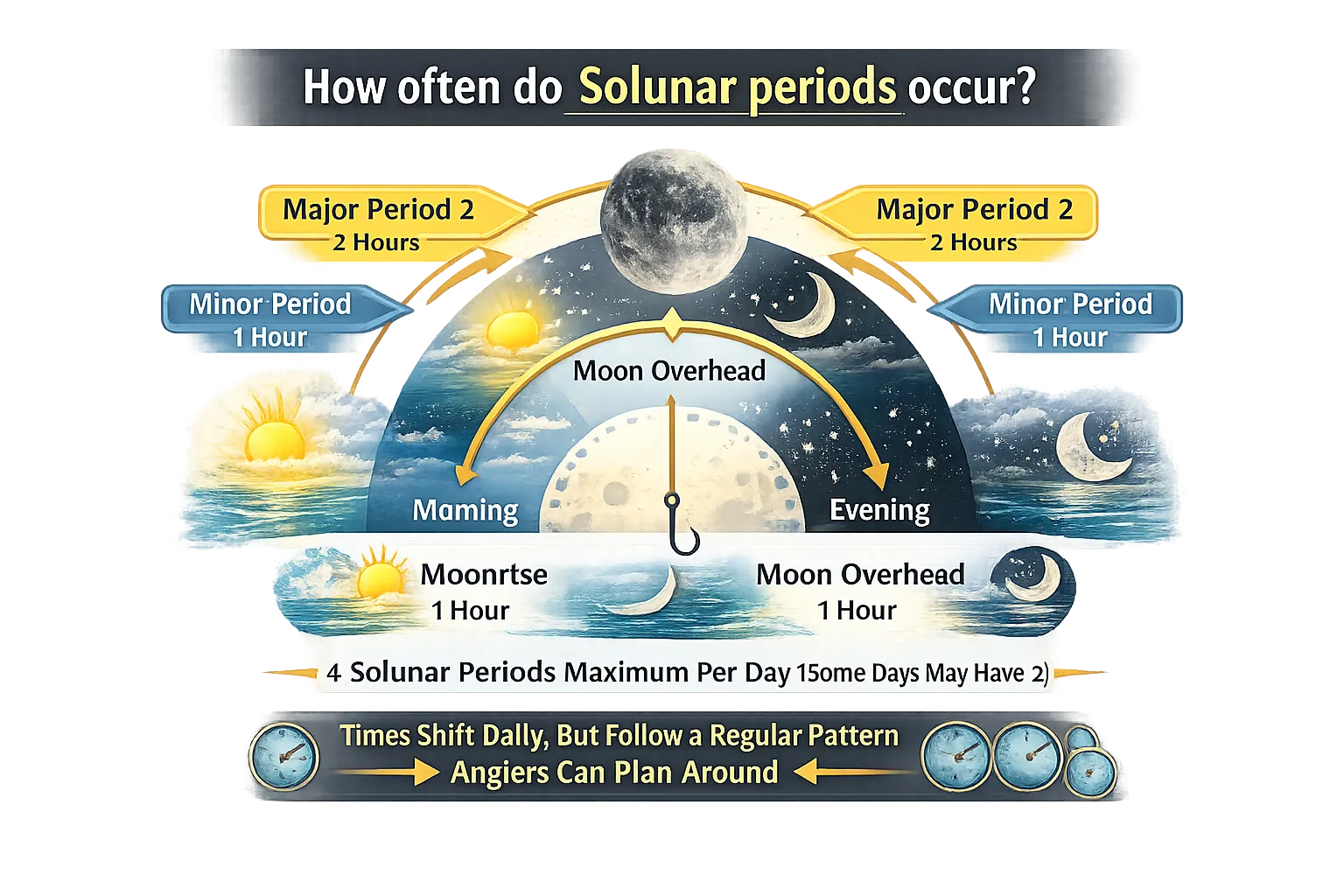
Solunar periods occur a maximum of four times each lunar day: two major periods and two minor periods. Some days may have only three periods, depending on the moon’s rise and set times.
- Major periods are longer and considered stronger when the moon is directly overhead or underfoot.
- Minor periods, on the other hand, are shorter windows tied to moonrise and moonset times.
The exact timing shifts daily as the moon moves, so they don’t stay fixed to clock time. This creates a predictable, regular pattern that anglers can plan around.
Is the Solunar theory real?
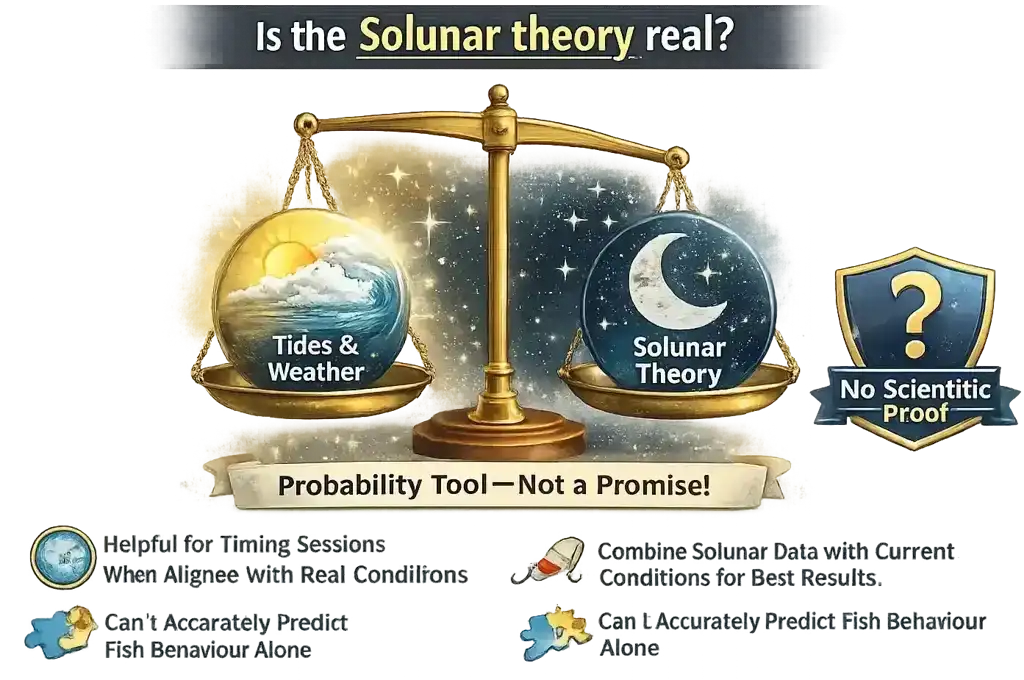
Solunar theory is used by many fishers. But it has not been scientifically proven to accurately predict fish behaviour.
This is because its almost impossible to create a testable environment that takes into consideration all the variables involved in fish behaviour.
Many anglers find it helpful for timing sessions, especially when it aligns with tides and weather. On its own, it won’t guarantee success, but when combined with real conditions, it can highlight genuinely productive windows.
At Getfished we take the view that Solunar is a factor, it’s worked for us quite a bit. But the other environmental factors come into play frequently.
Think of it as a probability tool, not a promise.
What does Solunar mean?
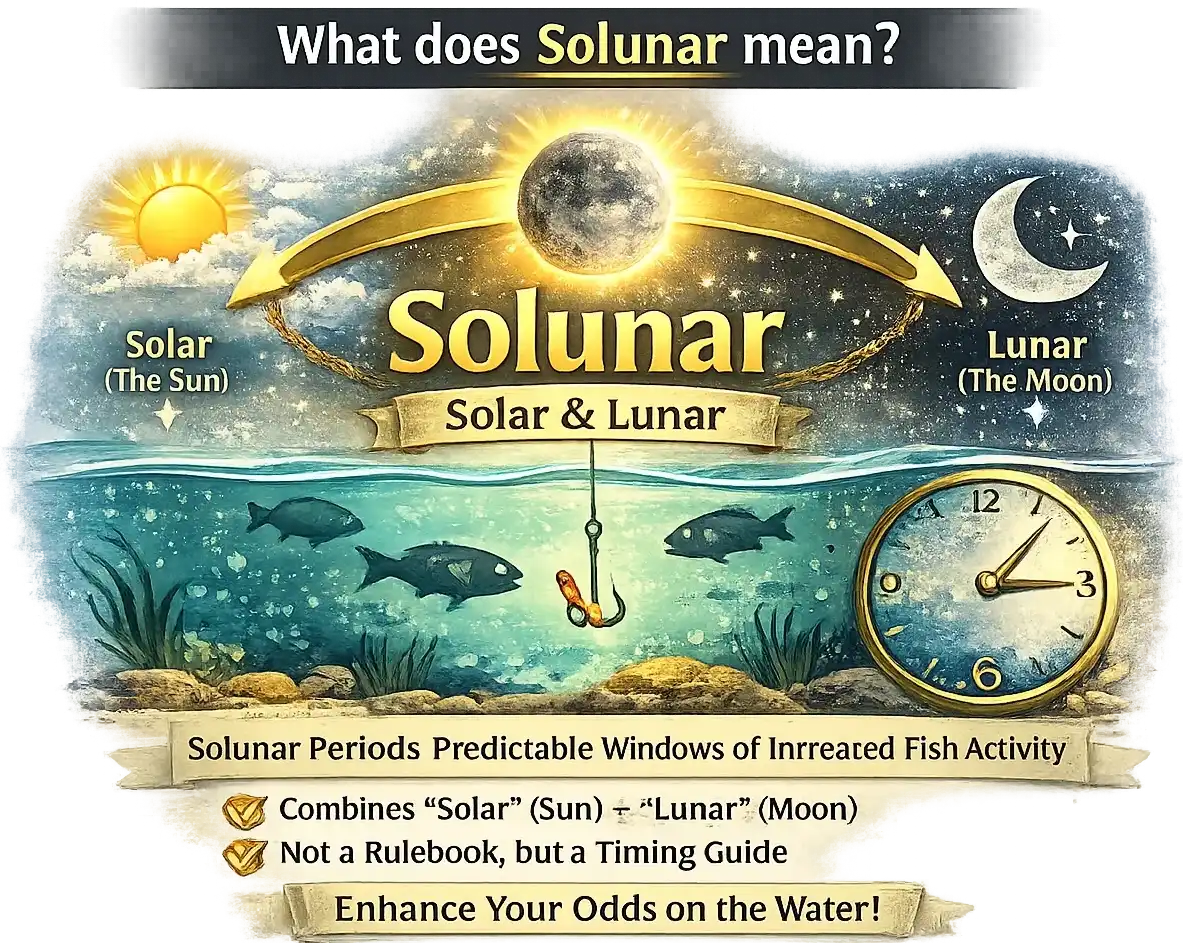
Solunar is a blend of “solar” (the sun) and “lunar” (the moon).
In fishing, it refers to the idea that fish feeding activity is influenced by the position of the sun and moon.
These positions create predictable windows—known as Solunar periods—when fish are more likely to be active. It’s not a rulebook, but a timing framework used to improve your odds on the water.
It is based on a theory proposed by ohn Alden Knight in 1926. The theory proposes that fish activity has peaks and troughs. Knight correlated these to the moon periods, rather than just the tides.
What is the best moon phase for fishing in Australia?
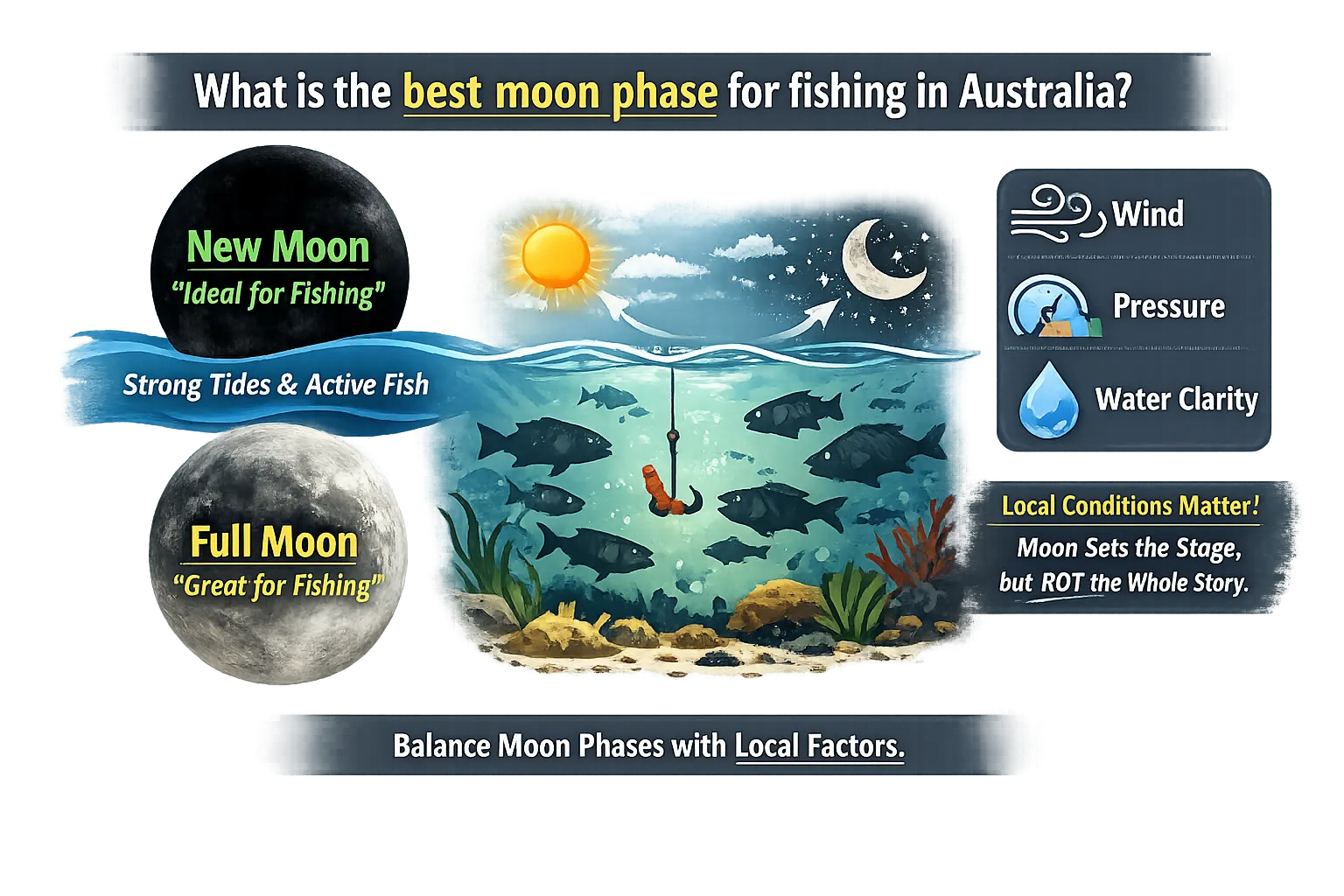
The new moon and full moon are generally considered the best moon phases for fishing in Australia and indeed most of the world. The new moon is particular is considered ideal.
These phases produce stronger tidal movement and more pronounced Solunar periods, which are believed to trigger feeding behaviour.
However, local conditions matter a great deal. Wind, pressure, and water clarity, for example, can override the moon’s effects. The moon sets the stage, but it doesn’t control all fish behaviour.
What is the strongest Solunar period?
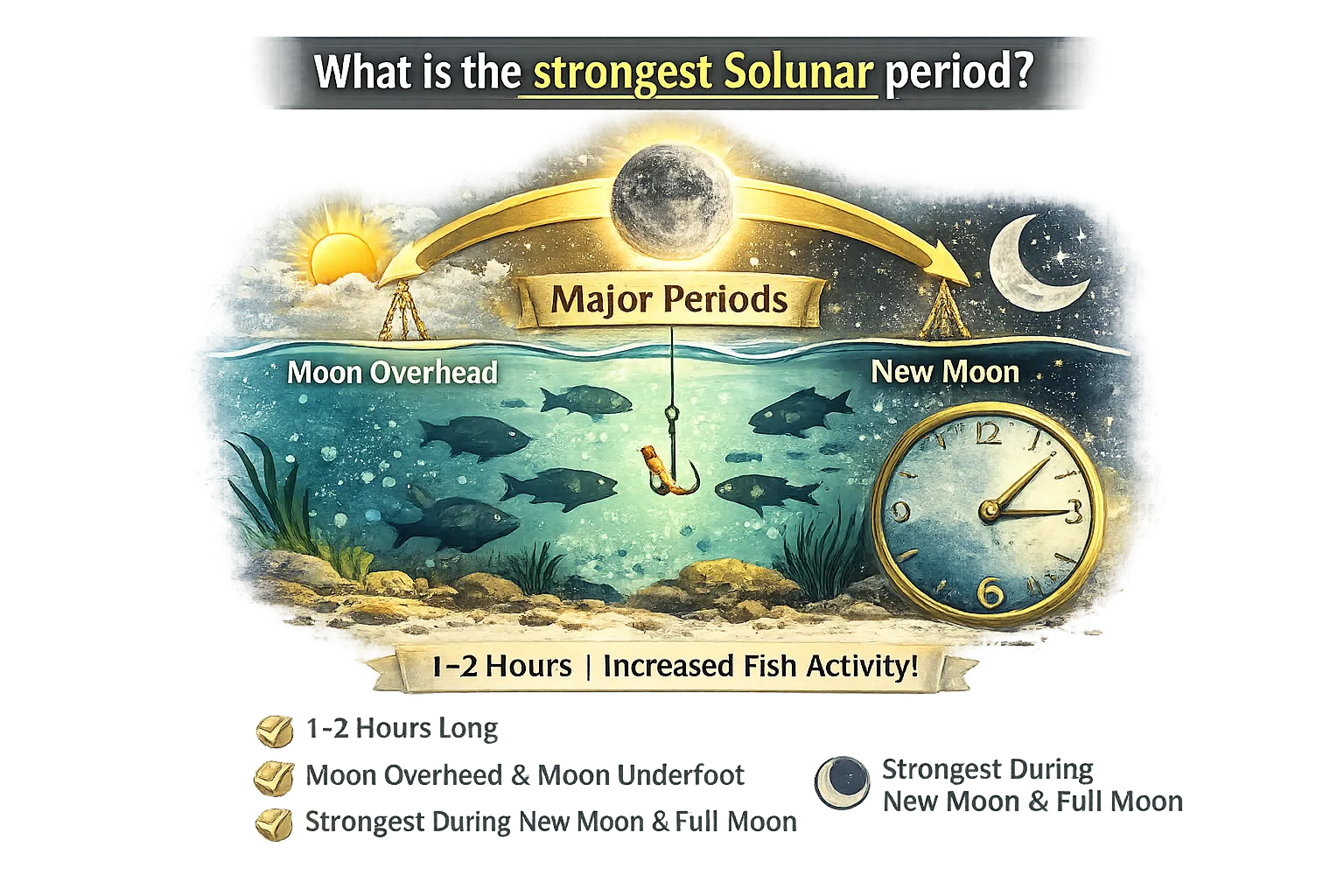
The strongest Solunar periods are the major and minor periods, which occur when the moon is directly overhead or underfoot. These windows typically last around 1–2 hours and often coincide with increased fish activity.
They are generally strongest during the new moon and full moon, when gravitational effects are at their peak. If you’re choosing one window to fish, this is usually it.
- The minor periods are moonrise and moonset. They see an increase in activity but it is not considered to be as strong as a Major period.
- A Major Period is aproximately the mid point between the two minor periods.
However due to the nature of the moons orbit, the curvature of the earth (it is not is not an even sphere) these periods vary across the Earths hemispheres. That variation forms part of the complexity of calculating the Major periods. Some tools fail to take this into account, causing times to be occur one to two hours out of sync.
Daylight savings time is another factor for time differences between tools. When these errors combine they can cause signficant errors in time calculations.
Getfished takes these factors into account for Solunar bite times, sunrise/sunset, moonrise and set as well as the tide times.
What moon do fish bite the most?
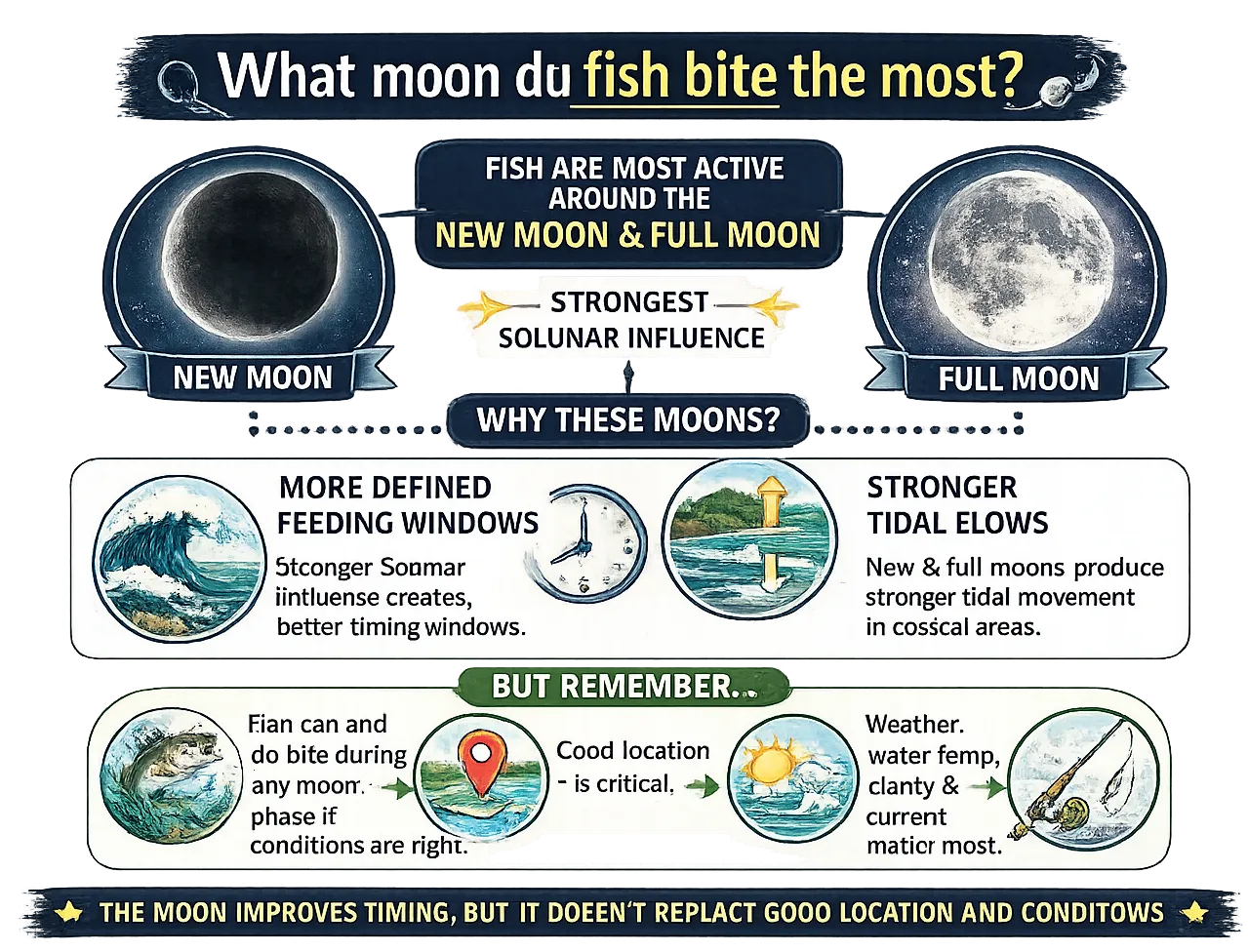
Fish are often most active around the new moon and full moon, when Solunar influence is considered to be strongest.
These phases tend to create more defined feeding windows and stronger tidal flows in coastal areas.
That said, fish can and do bite during any phase if conditions are right. The moon improves timing, but it doesn’t replace good location and conditions.
Because Solunar Theory has not been scientifically proven, nor even scientifically accepted, it is difficult to say exactly why fish might behave this way.
Some people propose its the tidal forces of the moon, others think it could be affecting the smaller organisms, at the level of plankton and below. With the effect moving further up the food chain due to the “increased activity” among those smaller organisms.
When’s the worst time to go fishing?
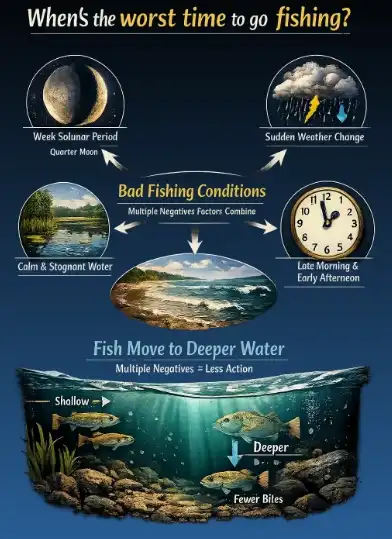
The worst fishing conditions usually occur during weak Solunar periods, such as quarter moons, combined with poor local factors.
Calm, stagnant water, unfavourable tides, or sudden weather changes can further reduce activity.
Late morning and early afternoon are often considered poor fishing times, but really, it’s about changing the depth at which you are fishing because the fish tend to move into deeper water.
It’s rarely one factor alone—it’s when multiple negatives stack together. Even then, fish can still bite, just less consistently.
For me, the worst time to go fishing is when I haven’t got the time to get out and cast a line!
Why do Getfished forecasts differ from generic advice?
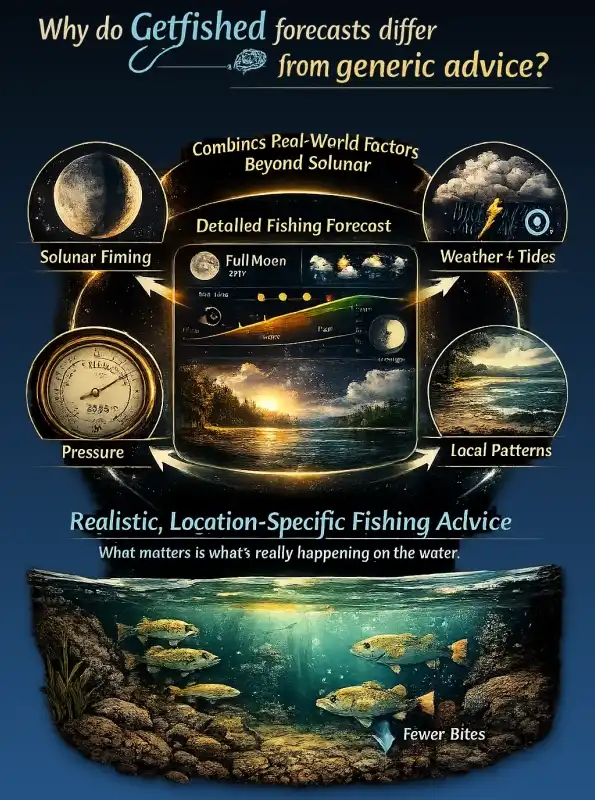
Getfished forecasts go beyond simple rules like “fish the new moon.” Instead, they combine Solunar timing with real-world conditions. These include weather, tides, pressure, and local behaviour patterns.
This produces a more realistic, location-specific view of fishing conditions.
The goal isn’t to follow tradition, but to reflect what’s actually happening on the water.
The combination of historical fishing report trends help suggest a location might be productive vs another location.
You are encouraged to make decisions based on all the information, not look for a “single signal”. There is no guranteed way of knowing when fish are going to bite, or even if the species you are targetting are present at all.