Solunar Theory Explained
TL;DR
- Solunar is a feeding intensity factor, not a fishing catch forecast.
- It can signal when fish might feed more, but it does not promise success or create fish where none exist.
- Tides, light, weather, season, water conditions and local knowledge usually matter more than solunar timing alone.
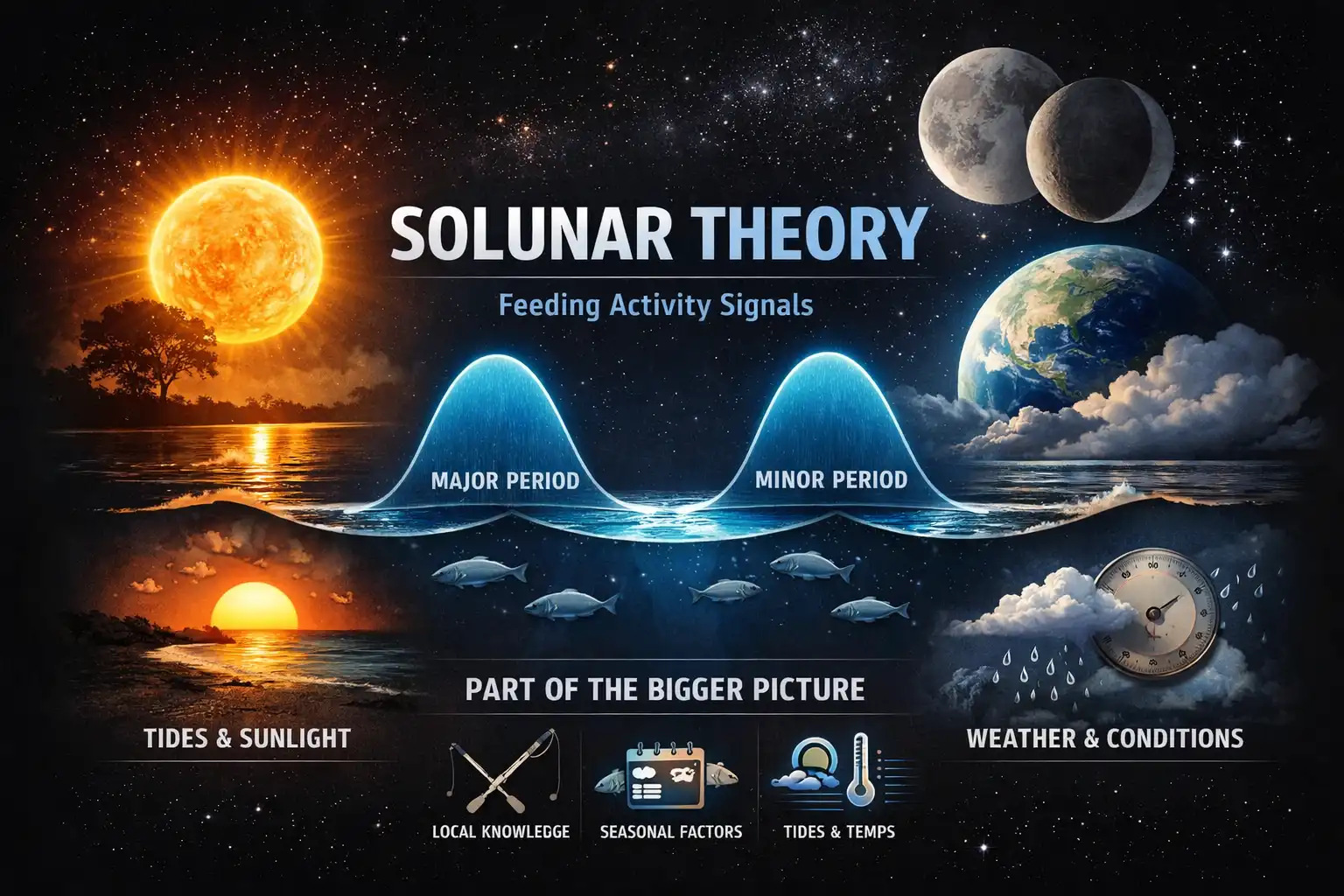
- Solunar works best as part of a bigger picture, alongside tides, weather, historical fishing reports and seasonal context.
- Never let solunar predictions stop you from going fishing. Use them to make better use of the time you already have.
Solunar is not a fishing catch forecast.
Let’s get this out of the way first:
Solunar theory does not predict whether you will catch fish.
It does not promise success.
It does not create fish where none exist.
Solunar only signals when fish might feed more. It does nothing else.
This difference is important because many people misunderstand solunar theory online. It’s often shown as a quick way to catch more fish, but it was never meant for that.
What is also important is that it is one of the few factors that can be calculated. We can predict the sunrise/sunset, the moonrise/moonset. To some extent the wind and weather and of course tides. We cannot predict when certain foods are available beyond very general terms and sometimes not at all. So solunar is one of those things we can predict. As such it’s part of the “whole” picture, not the “entire picture.”
What solunar theory actually describes
Solunar theory was introduced by John Alden Knight in the 1920s.
His observation was simple:
Fish and wildlife tend to show increased feeding activity during certain alignments of the sun and moon.
This led to the idea of short daily windows, called major and minor periods, when feeding activity may go up.
There’s an important word there: may.
Solunar does not:
Predict fish presence
Override tides, weather, or season
Replace local knowledge
It just points out times when fish might feed a bit more, if other conditions are already right.
Feeding intensity, not fishing success
The best way to explain solunar for fishing is this:
Solunar is a feeding intensity factor.
It affects how active fish might be, but not whether you can catch them.
Fish:
Still need to be present.
Still need suitable water conditions.
Still need food availability.
They still seem to react more to tides, light, and temperature than to solunar timing.
A high solunar rating does not mean:
Fish will bite aggressively.
Fish will be easy to catch
You will out-fish everyone else.
Likewise, a low solunar rating does not mean:
Fish have “shut down”
Fishing is pointless
You should stay home.
Fish exist regardless of where the moon is in the sky.
Why solunar is often overstated online
Many fishing widgets and apps reduce solunar data to:
Fish icons
Star ratings
“Good / bad day” labels
This can make people think solunar is the main reason for fishing success, which isn’t true.
It isn’t.
These shortcuts remove important context and make things seem more certain than they are. Solunar only works as part of a bigger picture, not on its own.
Confluence is the real mechanism.
Solunar matters most when other conditions already support feeding.
Common examples of stronger confluence:
Moving tides (especially a change of direction)
Sunrise or sunset
Stable or falling barometric pressure
Seasonally active species
Suitable water clarity and temperature
In these cases, solunar timing can help you pick when feeding might peak, but it doesn’t create the right conditions for feeding.
If those conditions are absent, solunar influence is often weak or invisible.
Why tides and light usually matter more
In practice, anglers consistently find that:
Tides
Sunrise and sunset
have a stronger and more reliable influence on fish behaviour than solunar timing alone.
That doesn’t mean solunar theory is wrong. It just shows its limits.
Solunar is a fine adjustment.
Tides and light are structural forces.
If you use solunar the right way, it helps you make the most of your time. If you use it the wrong way, it just turns into a superstition.
Used right it is an adjunct for planning. Used wrong you will “wait” for the “perfect time” and rarely get out fishing.
What solunar should and should not be used for
Solunar is useful for:
Refining fishing windows when time is limited
Comparing otherwise similar days
Adding context to tide and light-based planning
Understanding historical catch patterns
Solunar should not be used to:
Decide whether fishing is “worth it”
Replace tide charts or weather forecasts.
Override local or seasonal knowledge.
Judge fishing success in isolation
A simple rule works well:
Never let solunar predictions stop you from going fishing.
Use them to make better use of the time you already have.
There’s no “poor”, “bad”, “good” or “excellent” days as such when it comes to the solunar forecast. Its and estimate of the intensity of the bite.
Not “if the fish will bite.”
People trying to use solunar like a solid prediction saddens me. It can be a valuable tool if you understand what it helps you to do, or a useless tool if you treat it like an absolute.
Why does Getfished treat solunar this way?
Getfished does not treat solunar as a magic switch.
Instead, solunar data is presented as:
A signal, not a promise
A contributor, not a controller
One input among many
That’s why Solunar on Getfished sits alongside:
Tides
Weather
Historical fishing reports
Seasonal context
Each one gives you more information, but none of them guarantee results.
The honest takeaway
Fishing is not deterministic.
Forecasts are probabilistic.
Fish do not follow charts.
Solunar theory remains useful when:
Its limits are respected.
Its role is correctly understood.
It’s combined with real-world conditions.
When used right, solunar helps anglers plan better, but it doesn’t promise more fish.
And that’s exactly what it was always meant to do.
For more information on Solunar see the Solunar FAQ Page

Written by
Scott Kane
Founder, Getfished
Scott's a software developer and the founder of Getfished. He's a long-time recreational angler focused on practical fishing forecasts, fishing report data, and decision-support tools for Victorian anglers.
He has a background in complex software systems and data analysis. Scott has a penchant for building software using low level tools, developing products like Getfished in C, Pascal, SQLITE and Hugo.