How Getfished Fishing Reports Are Analyzed
TL;DR
- Getfished uses fishing reports as patterns over time, not as weekly snapshots that age quickly.
- A single report is a clue, but a collection of reports can show stronger evidence about species, locations, baits, seasons and trends.
- Report data is not certainty. It can be biased toward popular places, visible catches and what anglers choose to share.
- Trends help anglers move beyond broad species lists and get a more realistic sense of what is worth targeting.
- Getfished combines report trends with forecast information like tides, wind, weather, pressure and solunar activity.
- The aim is not to predict fish with certainty, but to give anglers a better frame of reference before deciding where and when to fish.
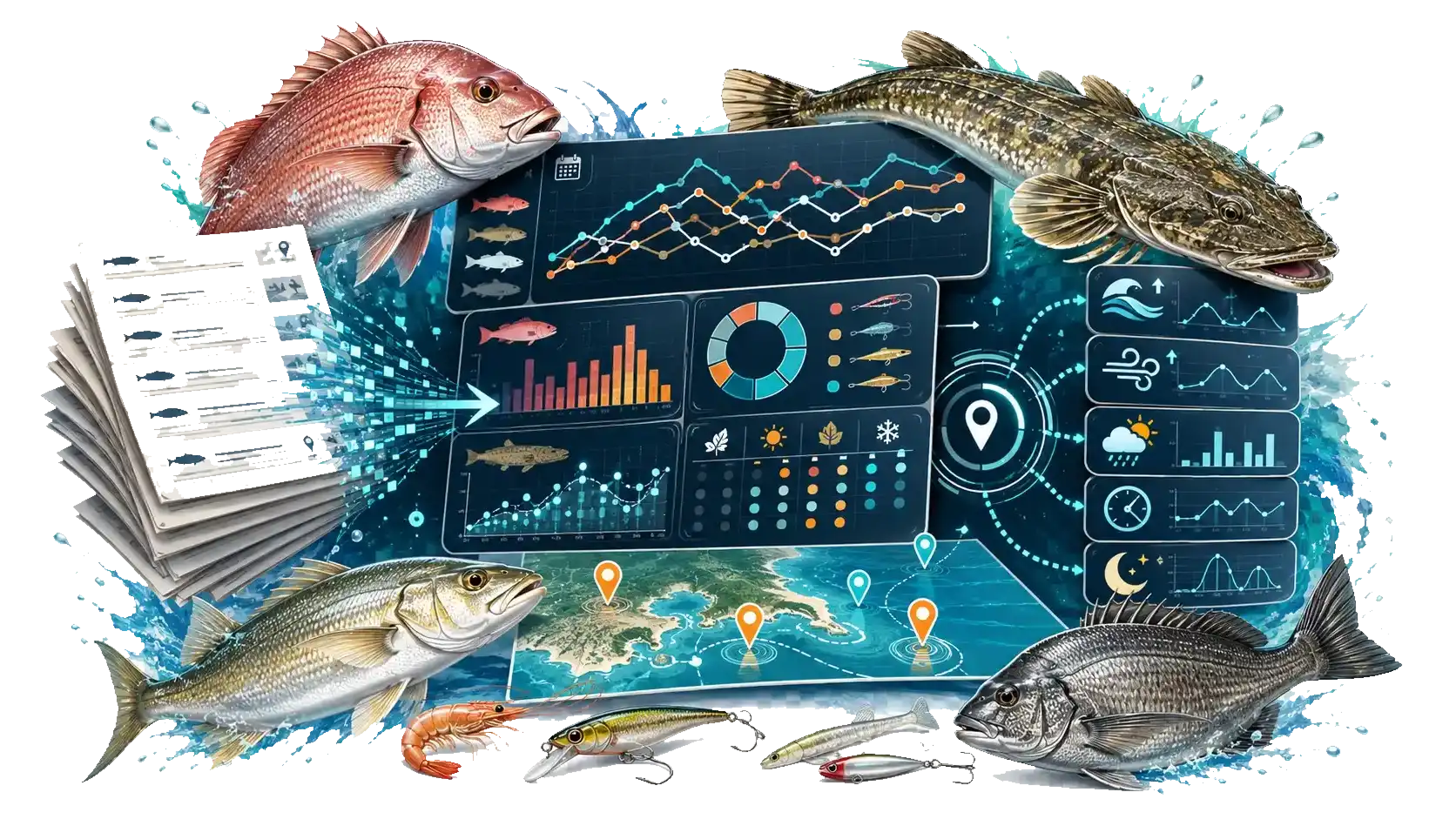
Fishing reports have always played a large part in how we anglers pursue fishing.
You ask at the local tackle shop, and they might say snapper are being caught in Western Port.
Someone else might mention flathead from a pier.
A fishing club member could say whiting were biting when the tide changed.
Still another report might note the fish were around last week, but this week’s wind made things tough.
Individually, these reports are useful. They give anglers a sense of what is happening on the water right now.
But at Getfished, we use fishing reports a little differently.
We are less interested in publishing a conventional “this week’s fishing report” and more interested in what fishing reports reveal over time.
Why We Don’t Publish Fishing Reports the Usual Way
Most weekly fishing reports are written as a snapshot.
Most reports I’ve seen - and I have seen a lot - tend to say things like:
“Snapper reports are on the increase in Port Phillip Bay, with pilchards. Some anglers report that squid is also working well. Flathead are active along the sand bars, especially on the runout tide. Garfish are showing up around the piers, with some good-sized models around Frankston being taken on maggots.”
That kind of report can certainly be helpful. Especially so when it is recent and local. It gives anglers a quick idea of what has been caught and where people are putting in the effort.
The problem is that weekly reports age quickly.
A report that was useful on Friday may be much less useful two weeks later. Weather changes. Water temperature shifts. Fish move. Anglers change tactics. Sometimes a report reflects one good session more than a broader pattern.
That does not mean old reports are worthless, far from it.
It means their value changes.
A single report is a clue. A collection of reports becomes evidence of a pattern.
That is the approach we take with Getfished.
Fishing Reports as Data, Not Just Stories
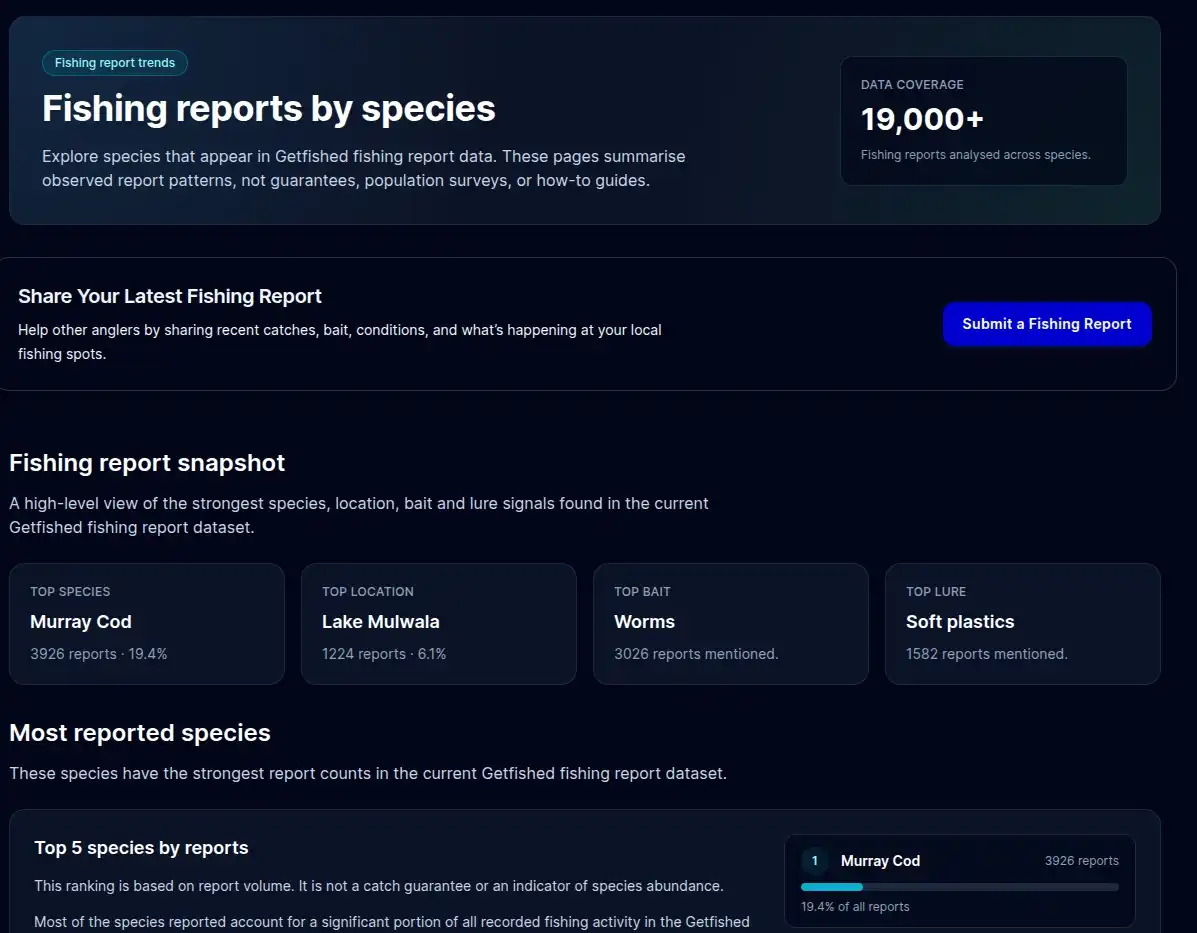
Getfished collects and organises fishing report information into structured records.
That means we look for practical details such as:
- What species were mentioned in reports
- what locations they were reported in
- What bait or lure was being used
- Is the report about a location, region, or broader area
- Is the time range the report was published aligned with a fishing period
We do not treat every report as perfect evidence.
Fishing reports are not scientific surveys. They are human observations or statements, often written casually. Sometimes with missing details, and commonly influenced by where people are fishing, rather than where the fish are most abundant.
Fisheries agencies such as NOAA place a strong emphasis on data quality and consistency when interpreting recreational fishing survey results. Getfished is not running a scientific survey, but the same general principle applies: incomplete or vague reports should be treated more carefully than clear, repeated observations.
This helps ensure our approach is transparent and that report trends reflect both the strengths and the limitations of the data.
But when enough reports are organised consistently, they become useful.
They can help answer better questions that we anglers are likely to ask, like:
- Which species are being mentioned most often around this location?
- Which baits are repeatedly associated with a species?
- Is a location producing the same reports across seasons, or only in short bursts?
- Are recent reports consistent with what anglers would normally expect at this time of year?
- Is it a species genuinely common in the reports, or just mentioned once?
That is more useful than simply saying, “You can catch snapper here.”
Indeed, because what we provide is an accumulative collection of reports, it is often better than: “I caught a snapper here.”
Fish, like most non-domesticated animals, follow high-level trends. Yearly, quarterly and monthly can be observed. Weekly and daily, however, are more likely to vary at a micro scale. With variations in pressure, rain and wind, as well as food availability, varying almost at random on smaller time scales.
Why Trends Matter More Than One Report
Many fishing guides describe a location in very general terms.
Quite often, they say things like a pier produces flathead, garfish, salmon, pinkies, bream, squid, or whiting. That could indeed be true. But there is a more useful question:
How often are those fish actually being reported?
There is a big difference between a species that is theoretically possible and a species that appears regularly in recent or historical reports.
A location guide may list ten species. But report trends might show that only three of them are commonly mentioned, two are seasonal, and the rest appear only occasionally.
That distinction matters.
Anglers do not just want a list of possible fish. They want a realistic sense of what is worth targeting.
This is where report-based trends help. They do not guarantee success, but they give better context than just a static list. Listicles on a website or book are useful in very broad terms, but don’t come close to matching actual insight based on data.
Reports Are Not Proof of What You Will Catch
Fishing reports can only tell us so much.
See, a fishing report is not going to prove that fish will be there when you rock up today. Reports from yesterday or last week took place under different weather patterns. Different times of the day. Different tides and even different foods that the fish were feeding on at that time.
Today, things could be the same, but are probably going to be different.
That top bait was working because it was what was available to the fish naturally (fishing the bite), but the same bait could be a waste of time tomorrow.
This is why Getfished provides trends. Not individual reports.
We can’t know about every quiet session that nobody bothered to report, or the “secret spot” anglers don’t share publicly.
Single reports certainly do not override the value of fishing skill and experience.
Report data can also be biased toward popular places and visible catches. A busy pier may generate more reports than a quiet estuary, even if the estuary fishes better for anglers who know it well. That does not make the reports useless. It simply means they need to be read as evidence of reported activity, not as a complete record of everything happening on the water.
Fishers making reports are also biased toward popular places.
A busy pier may generate more reports than a quiet estuary, even if the estuary fishes better for people who know it well.
So Getfished does not present report data as certainty.
We present it as past evidence that helps us decide on a specific location at certain time of the year.
If we use collated reports properly, they can show us what’s been happening. What species, locations or factors are being mentioned frequently? Suggesting what is worth taking into account when planning to go fishing.
Why This Helps Location and Species Pages
On Getfished, fishing report data supports both location pages and species report pages.
For a location page, reports can help show what anglers have been catching nearby.
For a species page, reports can help show where that species has been mentioned, what bait or lures are commonly associated with it, and whether the reports appear concentrated in particular places or seasons.
This makes the information more useful than a generic fishing guide.
Instead of only saying:
Flathead can be caught from beaches, piers and estuaries.
We can start to show:
- Flathead are one of the more commonly reported species for this area, with repeated mentions around sandy edges, piers and estuary mouths.
That is still cautious. It does not overpromise. But it is more grounded.
It can also show that some generalisations are not as well supported by the apparent “conventional wisdom” on when and where a species is found.
Why We Combine Reports With Forecast Information
Fishing reports tell us what has happened over a period of time. Allowing us to observe patterns.
The report trends help show what has happened before. The forecast helps you judge whether today’s conditions line up with those patterns. Use the forecast data to help you begin to think about what might happen in the immediate future.
- A location may have strong historical reports, but poor current weather.
- A species may be frequently reported in summer, but barely mentioned in winter.
- A good solunar period may line up with a poor wind direction.
- A change in the tide may look promising, but local conditions may make fishing uncomfortable or unsafe.
- A government authority might undertake a massive channel dredging project, and relocating the silt could adversely affect the feeding or breeding grounds of certain species.
This is why Getfished brings reports together - to test for trends.
Combined with forecast information such as tides, weather, wind, pressure and solunar activity, there should be an opportunity for you, the angler, to make a decision based on what you, too, observe from this information.
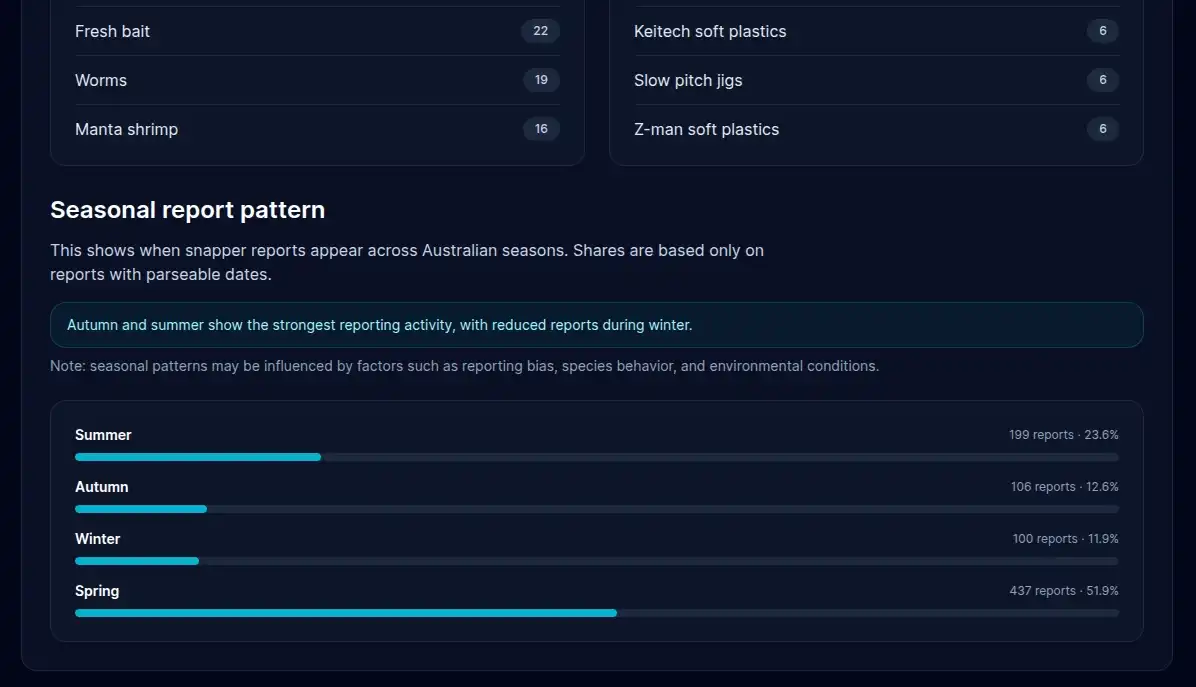
When do snapper tend to bite off Mornington?
What weather conditions are prevalent at that location? What tides? What are the suggested peak bite times for today or tomorrow?
Knowing both the seasonal trend and whether the forecast lines up.
A chance to combine what has happened with what is about to happen.
You, the fisher, can make more confident fishing decisions.
The aim is not to claim that a formula can predict fish with certainty.
It cannot.
The aim is to give you a better frame of reference before you decide where and when to fish. The species that are worth a crack right now. As well as whether or not prevailing conditions will make it worthwhile, difficult or suggest staying home warm and dry.
A More Useful Way to Read Fishing Reports
A single fishing report can be exciting.
A trend is usually more useful.
When you read report information on Getfished, it helps to think in terms of patterns rather than promises.
Look for repeated species mentions. Look for baits or lures that appear more than once. Look at whether the reports fit the season. Compare the report trend with the current forecast. Then make your own decision.
That is how experienced anglers tend to think anyway.
They do not rely on one clue. They build a picture from many clues: tide, wind, water, season, bait, local knowledge, and then what has been caught recently.
Getfished is designed to support that way of thinking.
Fishing reports are part of the picture.
Not the whole picture.
There’s no tool or website that can truthfully gaurantee you’ll catch fish. That’s why it’s called “Fishing” and not “Catching.”

Written by
Scott Kane
Founder, Getfished
Scott's a software developer and the founder of Getfished. He's a long-time recreational angler focused on practical fishing forecasts, fishing report data, and decision-support tools for Victorian anglers.
He has a background in complex software systems and data analysis. Scott has a penchant for building software using low level tools, developing products like Getfished in C, Pascal, SQLITE and Hugo.