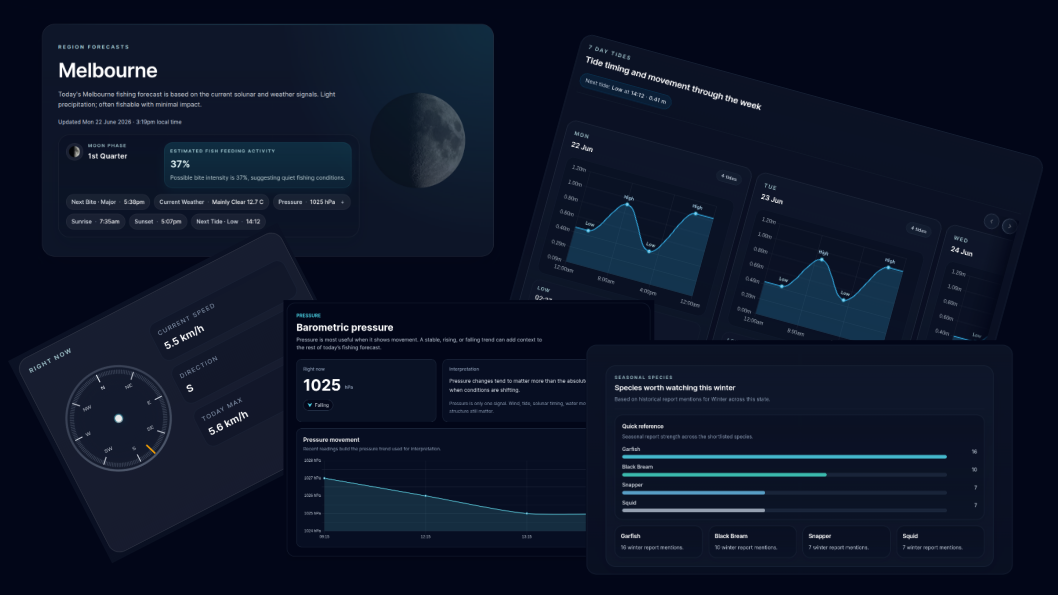
20,000+ fishing reports across 100+ locations & growing

Getfished: Today's Fishing Forecast Combining fishing conditions with real world fishing reports

Find the fishing forecasts, reports, and conditions that matter to where you fish. Use catch history, solunar timing, tides, and weather to build a clearer view of the day ahead.

Where. What. When.

No single source of data should ever dictate when you fish.

A better fishing forecast comes from looking at the conditions together. Getfished helps you compare the signals that matter, then apply your own judgement to the session ahead.

Where.

Forecasts should reflect where you actually fish. Nearby coastlines, bays, rivers, and offshore grounds can behave very differently on the same day.

  • Start with the area you actually plan to fish
  • Compare local conditions, not just statewide averages
  • Expect nearby regions to fish differently

What.

Solunar timing, tides, pressure, wind, weather, and catch history each add useful context. No single signal explains the whole picture.

  • Read the signals together
  • Look for overlap between indicators
  • Avoid leaning on one metric alone
  • Let changing conditions reshape the read

When.

The best time to fish is often a window, not an all-day rule. Good forecasts help you identify when conditions are aligning and when they are starting to shift.

  • Check timing, not just the daily score
  • Compare multiple signals before committing
  • Use local knowledge to confirm the call

How To Read The Forecast

Use the signals together, then make the call that fits your session.

Getfished works best when you compare conditions, pressure, tides, and local context instead of treating any one indicator as the answer.

Check Conditions.

Start with the broad picture. Look at forecast changes, tide timing, and the overall activity snapshot before narrowing your plan.

Compare Signals.

When reports, weather, solunar timing, and water movement align, you have a stronger reason to expect a window worth fishing.

Back Your Judgment.

Use the forecast to support decisions, not replace experience. Local knowledge, safety, and available time still matter most.

Browse Forecasts By State

Start broad, then narrow into the coast, region, and forecast pages that match where you fish.

Begin with your state to quickly find the forecast pages that matter where you fish.

Australian Fishing Forecasts & Reports

Fishing is complex. No algorithm owns it.

No Single Source of Data Should Ever Dictate When You Fish.

Getfished incorporates solunar theory as one component of a broader dataset. It describes what might influence activity, not what will happen. Use the data to compare conditions, then use your own experience to make the call. Signals guide you. They do not command you.

  • The best time to fish is when you have the time to get out there.
  • Use the data provided by Getfished as a guide to identify opportunities to improve your fishing.
  • Not a rock solid rule that must always be followed. No such rules exist.
  • Key factors can, however, guide us towards opportunities. No more and no less.

Today's Data Snapshot

A live view of the system behind the forecast.

Track the scale of the platform, the pace of updates, and the data signals shaping the forecast experience.

Fishing Reports Analysed

20,000+

Continuously growing as new reports are processed.

Forecast Locations

100+

Coverage expands as new forecast pages come online.

Update Frequency

Hourly

Forecast indicators and conditions are refreshed regularly.

Understand The System

Learn what the forecast is measuring and how to use it well.

The strongest results come when you understand what each indicator means, where it helps, and where experience still matters most.

How Getfished Works

Getfished brings together fishing conditions, tide movement, wind, weather, pressure, marine data, moon phase, solunar timing, and long-term fishing report patterns to help Australian anglers make better decisions.

The forecast is built around local conditions. Time zones, daylight saving, tides, moon events, weather changes, and marine conditions are handled for each location where data is available.

Fishing reports are treated as evidence over time, not perfect records. A single report can be late, vague, exaggerated, or incomplete. Patterns across many reports are more useful, especially when they show which species, baits, lures, seasons, and locations appear most often.

Solunar timing is part of Getfished, but it is not the whole answer. The best fishing decisions usually come from several conditions lining up.

Getfished is being built progressively, starting with Victoria and expanding across Australia as more forecast and report coverage comes online.

For more details, see our articles on how how Getfished Works.
Built For Real Fishing Decisions

Getfished is designed to help you make better calls on where and when to fish by combining historical patterns with current conditions. It is a planning tool, not a guarantee.